Series Preview: Pistons face uphill battle against Bucks in Round 1

1fd68345-88b4-42b0-9d66-a437f5cd1e3c-Pistons_Bucks_Basketball-GSN2AQDRV.1
(Photo credit: Jeffrey Phelps, Associated Press)

By now, you’ve probably heard the following tidbit at least 1,000 times.

Or maybe, 3,974 would be a more appropriate estimate, given that it’s been that many days since the Detroit Pistons last won a playoff game.

When the Pistons open their first-round series against the Milwaukee Bucks on Sunday, they’ll have a chance to end a 10-game playoff losing streak that spans nearly 11 years.

Easier said than done.

Detroit’s late-season struggles earned them a date with the NBA’s best team, record-wise. It’s the first time since the 1973-74 season that Milwaukee (60-22) has accomplished that feat.

The Pistons (41-41) needed all 82 games to squeak into the playoffs. Here’s a look at how they square up against their division rival.

Head-to-head

Yes, I know. Come playoff time, you’re supposed to throw the regular season series out the window. But let’s review what happened to add some context.

The Bucks swept the Pistons in the regular season for the first time in the franchise history, winning all four meetings. Milwaukee won by an average of 14.8 points per game.

That statistic is somewhat misleading. The Bucks won both games at home by 23 points. Only the second meeting on Dec. 17 was particularly close, as Milwaukee escaped Little Caesars Arena with a 107-104 victory.

The Giannis Factor

Depending on who you ask, Bucks’ forward Giannis Antetokounmpo is the favorite to win Most Valuable Player. (I happen to think that it’s James Harden, but that’s another story for another day.)

Though technically listed as a power forward, that’s more of a formality. The 24-year-old can play all five positions. He’s a matchup nightmare for even the best defenders.

I mean, how exactly do you contain a 6-foot-11-inch scoring machine? Better yet, one that can bully his way from the perimeter to the rim like a guard?

Good question. The other 29 head coaches in the NBA would like to know.

Antetokounmpo averaged 20.8 points, 8.8 rebounds and 7.0 assists per game against the Pistons this season. Not bad, considering he finished 2018-19 with a stat line of 27.7/12.5/5.9.

https://www.youtube.com/watch?v=F1vErTOth58

His kryptonite is 3-point shooting. Giannis only connected on 25.6 of his triples during the regular season.  However, he’s not the type of player that defenders should sag off of.

By daring him to shoot the three, you’re simultaneously ceding open floor space. And once he goes to his dribble, it’s nearly impossible to stop him. He scores 63.1 percent of his points in the paint

But where Antetokounmpo struggles is where his teammates pick up the slack.

Power of the pack

Former Piston Khris Middleton was named an All-Star for the first time in his career this season. Middleton is averaging 18.3 points, 6.0 rebounds and 4.3 assists per game on 44.1 percent shooting.  He’s also knocking down 37.8 percent of his 3-point attempts. 

Veteran center Brook Lopez has transformed his game in recent years and provides Milwaukee with another weapon to stretch the floor. In his first eight seasons, Lopez was 3-for-31 from beyond the arc. Since 2016-17, he’s made 35.4 percent of his 1,224 3-point attempts.

Fortunately for Detroit, Milwaukee has been bitten by the injury bug. The Bucks are currently short four rotation players in Malcolm Brogdon, Nikola Mirotic, Tony Snell and Donte DiVincenzo.

While known for his defense, Brogdon is an exceptional offensive talent. The combo guard is averaging 15.6 points, 4.5 rebounds and 3.2 assists per game on 50.5 percent shooting. He’s also shooting a team-high 42.6 percent from beyond the arc.

But Milwaukee is deep. Like very deep. I haven’t even mentioned starting point guard Eric Bledsoe, who, like Brogdon, is a very competent two-way player.

The Bucks have the league’s best record for a reason. Not only do they feature a transcendent superstar, but a supporting cast of veterans that compliments his ability. That doesn’t bode well for Detroit.

Is Blake back?

At the time of this post, it’s unknown whether or not Blake Griffin will suit up for Game 1 on Sunday night. He was in street clothes for the Pistons’ victory over the Knicks on Wednesday.

Detroit is 2-5 without Griffin in the lineup this season. When he is on the floor, the Pistons have an offensive rating of 111.3 points per 100 possessions. That drops to 106.1 once he steps off the court.

He led Detroit in points (24.5), assists (5.4) and minutes per game (35.0) in 2018-19. Griffin is the only Piston who can consistently draw double teams on offense. I broke down his importance to the team, and his historic season, back in February.

Prediction

There’s no way to sugarcoat it. Dwane Casey and his Pistons face an uphill battle.

And if they’re without Blake Griffin, it could turn into a massacre.

Milwaukee is primed to challenge the other heavyweights for Eastern Conference supremacy. Aside from the frontcourt, the Bucks have the upper hand across the board.

The Pistons will fight, scrap and claw just like they’ve done all season long. But it won’t be enough. Barring a heroic performance from Griffin, they won’t last very long.

Bucks in four.
 

Three takeaways from Detroit’s 123-110 loss to Oklahoma City

68260e86-f0f3-4562-bc2b-06028b40ff89-AP19096054036753
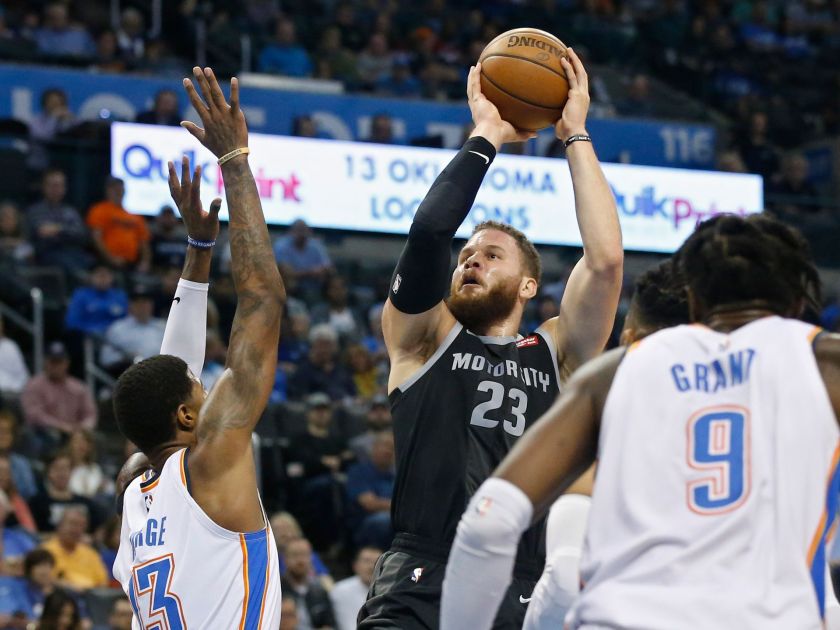
(Photo credit: Sue Ogrocki, AP)

Despite a 45-point night from Blake Griffin, the Detroit Pistons fell to the Oklahoma City Thunder 123-110 on Friday at Chesapeake Energy Arena.

Here are three takeaways from the loss.

1. Blake Griffin is back

For those who were questioning Blake Griffin‘s health, you can breathe a sigh of relief. Unless you’re the one who’s checking him at halfcourt.

Griffin shined in his return from a three-game absence, finishing with 45 points (on 11-for-20 shooting), seven rebounds, and three assists. He also nailed a career-high nine 3-pointers on 14 attempts.

The power forward carved up Oklahoma City’s defense in every way possible. Whether it was posting up on a smaller defender, or knocking down 3-pointers off the catch, Griffin was magnificent.

The Pistons needed every last bucket from their six-time All-Star. And it still wasn’t enough.

2. Foul trouble in the frontcourt

Both starting centers fell victim to foul trouble early on. Steven Adams picked up his third personal with 5:58 to play in the opening quarter. Andre Drummond (four points, nine rebounds) finished the period with two of his own.

Dwane Casey had to go with Zaza Pachulia (seven points, two rebounds) for an extended period of time, which invited Oklahoma City to attack the basket with ease. The Thunder outscored Detroit 64-30 in the paint.

Pachulia isn’t quick enough to slide over and stop penetration on the weak side. And to make matters worse, Zaza committed his second foul well before halftime.

Without Griffin’s heroics, this would have been a very one-sided game in favor of the Thunder. Drummond, in particular, can’t allow this to happen again in the final three games.

3. Guard play non-existent

Reggie Jackson (10 points, three assists) and Ish Smith (12 points, four assists) struggled against Oklahoma City’s punishing defense. They shot a combined 9-for-24 from the floor.

Smith forced a couple of bad layups that were quickly swatted away by Nerlens Noel. Jackson settled for some less-than-ideal 3-pointers that clanged off the iron.

Clean passes were hard to come by. Especially against a Thunder team that defends so well away from the ball. Still, Jackson and Smith must find a way to get others involved.

Top All-Star moments in Pistons history


IMG_20181115_163420
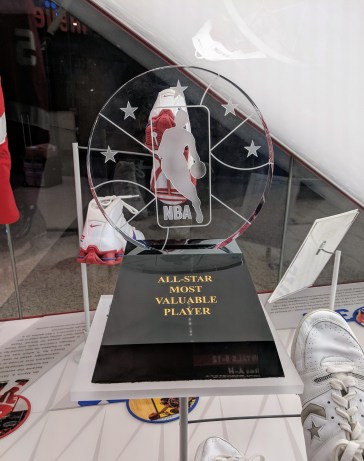
Isiah Thomas’ 1986 All-Star Game MVP trophy sits on display at Little Caesars Arena in Detroit. (Photo credit: Brenden Welper)

When Blake Griffin checks in at the scorer’s table on Sunday in Charlotte, he’ll join a select group of Detroit Pistons.

Of the 487 players to wear a Pistons’ uniform, only 33 (rough 6.8 percent) have represented the club in an NBA All-Star Game. Griffin will be the 34th to do so.

Before this weekend’s festivities commence, here are the top All-Star moments in Pistons history.

Isiah Thomas wins MVP: 1984, 1986

Technically, these are two moments that I’ve sandwiched into one. But hey, it’s my website, so I’m going to allow it.

For the first twelve seasons of his 13-year career, Isiah Thomas never missed an All-Star Game. He also collected some hardware along the way.

Thomas led the Eastern Conference to a 154-145 overtime victory in 1984. His 21-point, 15-assist double-double earned him the game’s MVP award. He joined Bob Lanier as the only Piston to achieve that honor.

Thomas would outdo himself two years later in 1986. Zeke finished with a game-high 30 points on 11-for-19 shooting while adding 10 assists and five steals.

He was named the MVP for the second time in three years, and also became the fifth player in league history to win the award more than once.

Four Pistons check in together: 2006

The NBA All-Star Game is a celebration of individual greatness. But on rare occasion, it can showcase that the whole is greater than the sum of its parts.

Perhaps there is no better example of that than the 2006 Detroit Pistons. For just the fifth time in NBA history up to that point, a single team was represented by four players in the All-Star Game.

Chauncey Billups, Richard Hamilton, Ben Wallace, and Rasheed Wallace were selected as All-Star reserves for the Eastern Conference. Billups had the best performance out of the bunch, finishing with 15 points, seven assists and four rebounds.

Detroit would go on to win a franchise-record 64 games that season. Though they ultimately fell to the Miami Heat in the Eastern Conference Finals.

Bob Lanier’s standing ovation: 1979

This one may come as a surprise for several reasons.

Yes, Bob Lanier was a seven-time All-Star with the Detroit Pistons. And yes, he was also the MVP of the 1974 mid-season classic. So why did I single out his final All-Star appearance as a Piston?

Simple. The 1979 edition was the last NBA All-Star Game to be played in the Detroit area, having been held at the Pontiac Silverdome. The Dobber posted a forgettable 10 points, four rebounds and four assists.

But it was the 25-second standing ovation Lanier received during the player introductions that made his eventual stat line irrelevant.

Heck, the ovation would’ve lasted longer, if not for Brent Musberger interrupting  Lanier’s home crowd to continue down the roster.

Despite the Pistons’ futility, Blake Griffin is making history in Detroit


img_20181115_162533
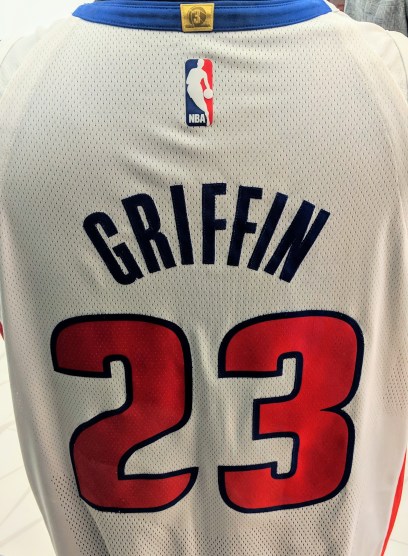
The jersey worn by Blake Griffin during his Detroit Pistons’ debut is seen on display at Little Caesars Arena in Detroit on Nov. 15, 2018. (Photo credit: Brenden Welper) 

Later this month will mark the one-year anniversary of the Detroit Pistons trading for Blake Griffin.

A lot has changed since that night in January 2018.

Stan Van Gundy and Jeff Bower have been replaced by Dwane Casey and Ed Stefanski.

The ruler of the Eastern Conference that was LeBron James is now west of the Mississippi River.

Finally, the Pistons yield an offensive force the likes of which they haven’t seen since the color teal adorned their uniforms.

That force is the 29-year-old Griffin, who has resurrected his career halfway through the 2018-19 NBA season. At the time of this post, he’s averaging 25.5 points, 8.1 rebounds and 5.2 assists per game while shooting 48.0 percent from the floor and 33.5 percent from deep.

Those are All-Star worthy numbers, and it’s very likely that he’ll represent the Pistons during February’s annual exhibition in Charlotte. But that stat line is only a small indicator of just how special his 2018-19 campaign has been up to this point.

If the season ended today, Blake Griffin’s scoring average of 25.5 (a career-high) would rank eighth all-time in franchise history. Only Jerry Stackhouse, George Yardley, Dave Bing (who did it twice), Kelly Tripucka, Grant Hill and Bob Lanier have averaged more points per game in a single season as a Piston.

Four of those men are in the Hall of Fame, and two of them have their numbers retired in the rafters at Little Caesars Arena.

Remember, the Pistons joined the NBA in 1948. Griffin could become just the seventh player in team history to average at least 25 points per game in a season.

Milestones such as these aren’t met very often. He’s in the midst of something remarkable.

Griffin’s current usage percentage of 29.7 is also the sixth-highest in Pistons’ history, and the second-highest of his career. He leads the NBA in touches per game with 93.8. Detroit’s offense doesn’t just run through Griffin, it is Griffin.

When he’s not operating with the ball in isolation, he’s facilitating to his teammates as a point forward. Not surprisingly, the five-time NBA All-Star leads the club in assists per game.

The Pistons generate clean looks from beyond the arc thanks to the double teams that Griffin commands. Once a second defender clamps down onto him in the post, he kicks the ball back out to the open man. Shooting guard Reggie Bullock is the usually the benefactor of those catch-and-shoot opportunities.

When No. 23 is on the floor, Detroit is scoring 113.4 points per 100 possessions. That offensive rating drops to 104.4 the moment Griffin steps off the hardwood. So, for the roughly 11.9 minutes per game that he’s on the bench, the Pistons’ offense is treading water.

Arguably, the only knock on Griffin is that he is one man. In other words, there’s only so much he can do for Detroit.

Basketball is a team sport. Griffin’s individual dominance on a mediocre club with a 19-24 record is evident of that.

Take him off the Pistons, and they’d have no go-to scorer. They’d have no true play-maker. Most importantly, they’d be without a player that can constantly shoulder the offensive burden – and even that ability only takes a team so far.

For a fan base that hasn’t seen a playoff victory in over 10 years, it may be hard to appreciate individual success while suffering through collective ineptitude.

Still, it shouldn’t be unfamiliar to those who watched Bing, Lanier and Hill experience the same process. Some of the best to ever wear a Pistons’ jersey were the franchise’s lone bright spot in a constant storm of chaos.

Maybe Griffin is destined for that same fate.

Then again, maybe not. Who knows what the final 39 games will bring this season?

Come April, the 2018-19 Detroit Pistons could very well be an afterthought. Blake Griffin’s ninth year in the NBA should be anything but.


New Year’s resolutions for the Detroit Pistons entering 2019

IMG_20181123_191133
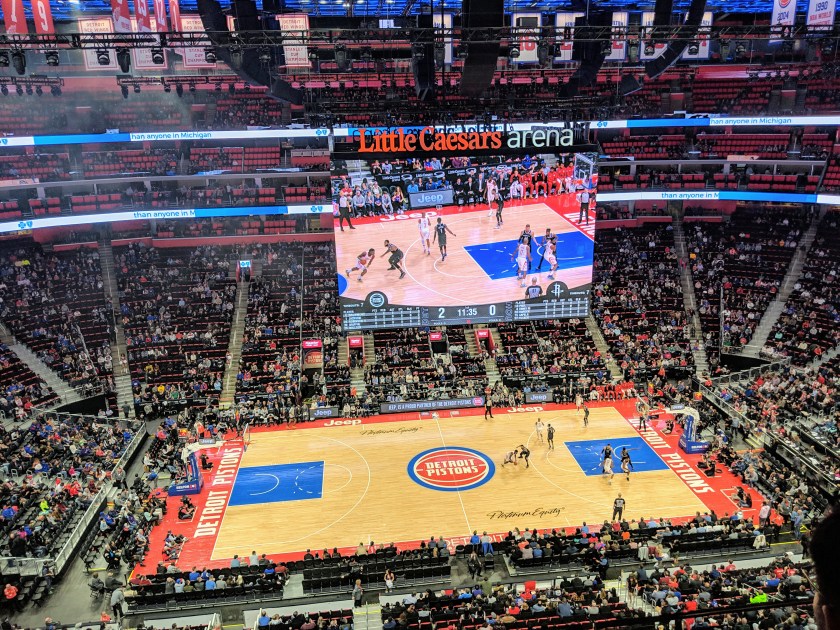
The Detroit Pistons host the Houston Rockets on Nov. 23, 2018 at Little Caesars Arena in Detroit. (Photo credit: Brenden Welper)

The arrival of every calendar year is accompanied by optimistic New Year’s resolutions.

For many, these goals may be eating healthier, losing weight, or taking that next step in a professional career.

With the Detroit Pistons currently sporting a 16-18 record, I figured that this inconsistent ball club could use some resolutions of their own.

Let’s just hope these changes extend beyond January.

1. Remain healthy

Their first resolution is easier said than done.

The Pistons’ last two seasons were marred by injuries. Reggie Jackson missed significant time in both 2016-17 and 2017-18, appearing in only 97 games during that span.

While he’s played in every contest thus far, overall health remains an issue in Detroit this season.

Backup point guard Ish Smith has been out with a right adductor muscle tear that he suffered back on Dec. 5 in a 115-92 loss to the Milwaukee Bucks. The Pistons are 3-9 in their 12 games since.

According to James Edwards III of The Athletic Detroit, Smith’s recovery will continue for at least another two or three weeks.

Detroit has noticeably missed its up-tempo reserve guard. Per Basketball Reference, the Pistons have an offensive rating of 115.6 points scored per 100 possessions with Smith on the floor. Without him, that rating plummets to 108.6.

That’s a monumental drop off with the absence of just one player. But Smith creates opportunities for himself and others off the dribble – a skill that the Pistons lack outside of Smith, Jackson and Blake Griffin.

2. Increase off-ball movement

It should come as no surprise that Detroit forward Blake Griffin leads the NBA in touches per game with 91.8.

The Pistons also rank third in post ups per game, averaging 16.3 a night. Griffin accounts for 9.0 of them, and is scoring 4.1 points per game on post touches – the fifth-highest in the league. He is shooting 49.5 percent from the floor on post touches as well.

While teams have sought to double team Griffin, he’s done a solid job of kicking the ball back out and finding the open man.

However, the Pistons should increase their movement when the ball is in Griffin’s hands. Far too often, they’re standing around watching him go one-on-one. Here’s an example of what not to do.

Sure, Griffin ended up making the basket anyway. But before he spun away from Russell Westbrook and drove baseline, his eyes were fixated on his teammates. Nobody chose to cut inside, so he quickly took matters into his own hands and delivered.

But if he misses that contested shot, it’s very unlikely that Detroit gets the offensive rebound. Even if Griffin chose not to hit a cutting teammate, having that extra body crash towards the basket increases the likelihood of an offensive board.

Now let me be clear. I’m not suggesting that they veer off into his driving lane while he’s isolated. That defeats the purpose an isolation set.

What I am suggesting, however, is that the Pistons maintain some sort of movement while all five defender have one eye focused on Griffin. Something like this would suffice.

Reggie Jackson’s cut pulls Evan Fournier away from Griffin. This forces D.J. Augustin to collapse onto Blake, which leaves Bruce Brown open on the perimeter. Brown then makes a basket cut of his own (while simultaneously calling for the ball) and finds an open seam.

Griffin didn’t use Brown in that situation. But Brown’s cut could’ve led to a put-back attempt or an offensive rebound.  It’s that very willingness to exploit defensive breakdowns that the Pistons must embrace.

3. Feed Stanley Johnson in transition

One of the bright spots of the 2018-19 campaign has been Stanley Johnson‘s poise leading the break.

No player that has appeared in at least half of the Pistons’ games this season has averaged more fast-break points per game (1.5) than Johnson. Luke Kennard has a better overall average with 1.9, but he’s only played 47 percent of Detroit’s schedule to date (34 games).

The Pistons rank 24th in fast-break points per game, averaging only 10.5 per contest. So deferring to Johnson in transition more often is worth exploring, since they’re not much of a threat in the open floor.

Standing at 6 feet 7 inches tall, the 22-year-old’s frame make him difficult to guard at full speed. Defenders in transition are often backpedaling and off balance, giving the ball handler a serious advantage if contact is made.

By no means is he akin to Russell Westbrook or John Wall. His ability to finish remains a work in progress, and Johnson doesn’t look to pass on the break as often as he should.

But he’s shown enough to justify getting the ball in transition.